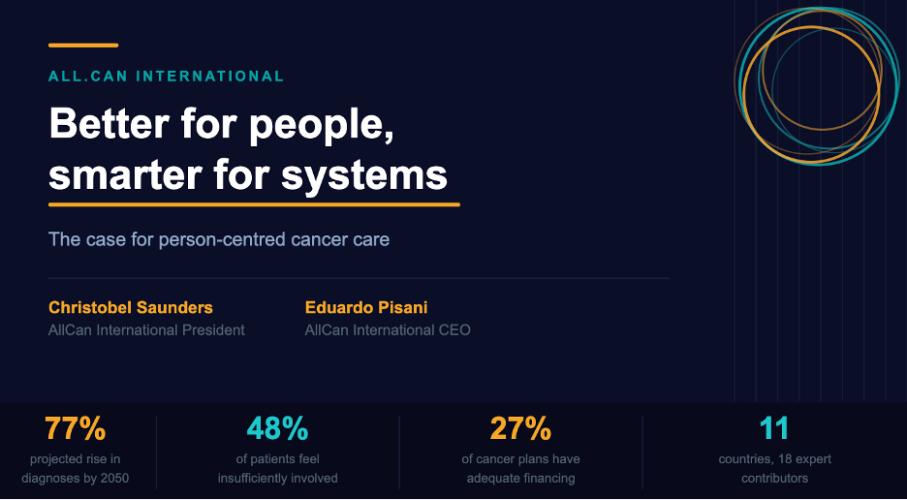
Co-authored by Christobel Saunders, AllCan International President and Eduardo Pisani, AllCan International CEO
Almost half of people living with cancer feel they are not sufficiently involved in decisions about their own treatment. That is not a minor shortcoming. It is a signal that health systems are organised around their own structures rather than the people they exist to serve and it is costing both lives and resources. Global diagnoses are projected to rise by nearly 77 per cent by 2050, and health systems cannot afford to keep organising care this way.
We believe there is an answer, and the evidence to support it. That is why All.Can International has published Implementing Person-Centred Cancer Care to Improve Outcomes, Experiences and Efficiency: a global report drawing on five years of peer-reviewed literature and expert input from 18 contributors across 11 countries, accompanied by a case study compendium documenting twelve international examples whose findings are striking in their consistency.
Across twelve countries – from Sweden’s nationally mandated care pathways to the Philippines’ Cancer Assistance Fund, from Brazil’s mobile lung cancer screening initiative to the UK’s holistic needs assessment model – the case studies document the same structural pattern: the gap between policy intent and operational delivery is driven by fragmentation. Fragmentation between data systems. Between clinical disciplines. Between primary and secondary care. Between what health systems plan and what people with cancer actually experience.
This is not simply a quality problem. It is an efficiency problem. Fragmented care generates duplication, delays, unnecessary hospitalisations and missed opportunities for early intervention. It is, in the most direct sense, a poor use of the resources health systems posses, resources that will come under even greater pressure as incidence rises.
Person-centred care is not a luxury. It is the most efficient way to organise cancer care and the evidence for this is now too strong to ignore.
Our report identifies seven concrete steps. They encompass timely diagnosis, coordinated multidisciplinary care, digital tools, remote care, shared decision-making, survivorship support and financial protection. None of these is novel in concept. What the report provides for the first time in a single integrated framework is the evidence base, the policy mechanisms and the international case studies to make them actionable in any health system context.
The timing of this publication is not incidental. The World Health Organisation, the UICC and the OECD are converging on the same evidence base: three independent bodies, three different mandates, one conclusion. Health systems need high-value, people-centred cancer care and not more of the same fragmented, disease-centred approach. This is not a regional debate. It is a global one, playing out in every health system grappling with rising incidence, finite resources and the growing distance between what cancer plans promise and what people with cancer actually experience.
Despite this, only 27 per cent of national cancer plans globally carry adequate financing strategies. In many countries, political commitment to reform is genuine. The translation from commitment to funded, monitored, time-bound implementation is where ambition consistently falls short.
So, the question before policymakers and health system leaders is not whether the framework is sound. It is whether the political will exists to fund and implement it.
Cancer systems will either reform on their own terms or be forced to by rising demand and shrinking resources. This report shows how to do it well, and on time.
Signed by the All.Can International Board: Matti Aapro (Clinique de Genolier), Bettina Borisch (Institute of Global Health, University of Geneva), Nicolo Conti (BMS), Ebba Hallersjo Hult (Vision Zero Cancer), Matt Hickey (The Health Value Alliance), George Kapetanakis (Hellenic Cancer Federation), Darien Laird (Global Coalition for Radiotherapy), and Michael Oberreiter (Roche).