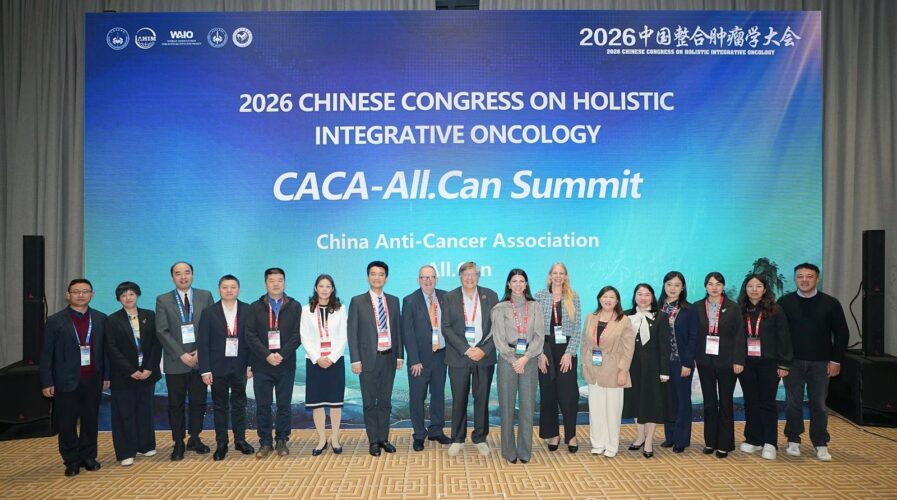
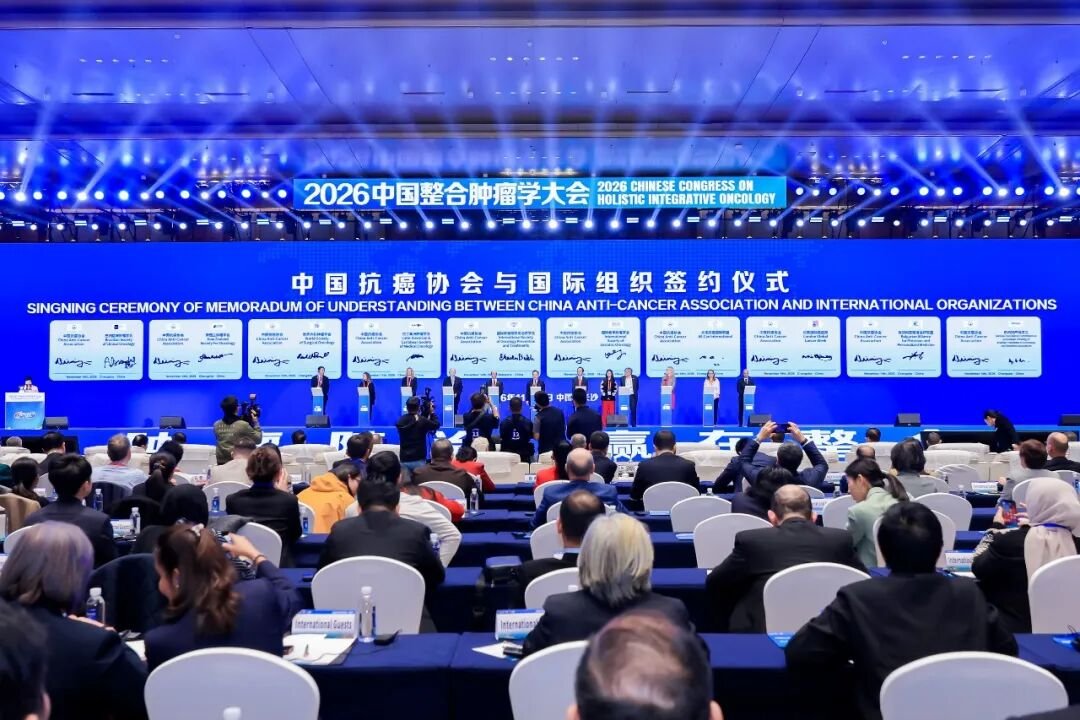
All.Can International and the China Anti-Cancer Association (CACA) have signed a three year Memorandum of Understanding. The agreement was signed in Changsha during the 2026 Chinese Congress on Holistic Integrative Oncology, at a ceremony in which CACA formalised partnerships with a group of international organisations.
CACA is China’s national association for cancer prevention, treatment and research. Its “3 ALL” strategy, all for cancer, for all cancer, for cancer, all, sets out an integrated approach to oncology that places patient navigation at the base of the care pyramid. All.Can brings a decade of evidence on where cancer care loses value for patients, and a network of National Initiatives in 17 countries working to turn that evidence into change. Both organisations are keen to work together on projects that make cancer care more efficient and more person-centred, and the Memorandum gives that intention a three year horizon.
The first CACA All.Can Summit
The partnership opened with a joint session on the morning of 15 November at the Changsha International Conference Center, under the theme “Cooperation and collaboration to improve cancer patient outcomes”. Dr Matti Aapro, a founder and Board member of All.Can, and Professor Jun Zhang, Chief Oncologist at Ruijin Hospital, Shanghai Jiao Tong University School of Medicine, co-chaired the session and gave the opening remarks.
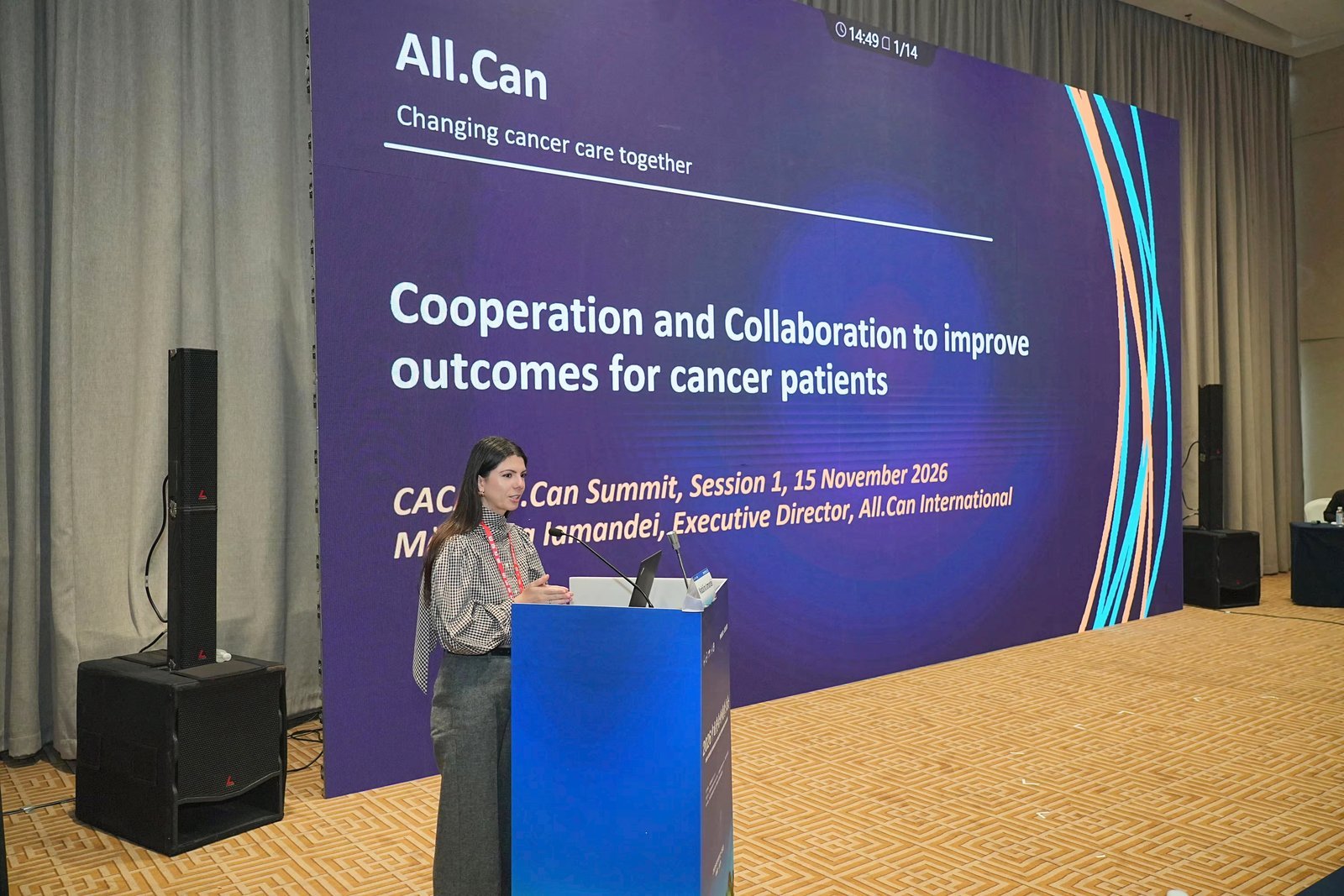
All.Can International and local All.Can achievements. Mădălina Iamandei, Executive Director of All.Can International, introduced All.Can’s work through the question that unites it with CACA’s own agenda: how to focus resources on what matters to patients when demand rises and budgets do not. She traced the route from evidence to action: the International Patient Survey, in which 31% of patients felt inadequately informed and only 53% felt involved in decisions about their care; the Efficiency Hub of evaluated initiatives; the 2026 report Implementing Person-Centred Cancer Care to Improve Outcomes, Experiences and Efficiency and its seven step pathway; and the Action Guide for Efficient Cancer Care, now applied in Greece, Mexico, Australia, Canada and Romania. The same tool has shown the same pattern on four continents: strategic intentions are in place, but they are not yet translated into results for patients. Examples from National Initiatives, from Colombia’s ten year cancer plan to Spain’s work on long term survivors in regional budgets, showed how locally owned initiatives turn evidence into policy.
How CACA improves cancer outcomes within budget constraints. Dr Qinghua Yao, Chief Physician and Vice President of the Second Affiliated Hospital of Zhejiang Chinese Medical University, described CACA’s approach to improving outcomes with finite resources, a question that sits at the centre of All.Can’s own work. Professor Huan Zhang, Deputy Director of the Department of Radiology at Ruijin Hospital, moderated.
Increasing collaboration between Europe and China in the medical area. In a recorded address moderated by Dr Aapro, Dr Pietro Presti, Managing Director of the Edo ed Elvo Tempia Foundation, set out the case for closer Europe China cooperation in oncology. China now accounts for around 35% of new oncology clinical trials by sponsor headquarters, against 21% for Europe. He proposed a selective, project based agenda in four fields, AI imaging and digital pathology, precision oncology, clinical research and development, and digital oncology and real world data, with clear rules on regulation, data, intellectual property and accountability.
The context of China: opportunities to accelerate patient navigation. Dr Yingna Bao of the Affiliated Hospital of Inner Mongolia Medical University presented the state of patient navigation in China and where it can grow. The Chinese Oncology Nursing Society has been active across 30 provinces since 2018, and the CACA Case Management Committee, established in 2023, now counts 157 institutional members and more than 6,000 individual members across 12 specialty groups. She showed how Ruijin Hospital’s Rui Link digital ecosystem connects hospital, data and family through a watch and a phone, for continuous care from hospital to home. Professor Xiaobing Huang of the First Affiliated Hospital of Fujian Medical University moderated.
Panel: an international pathway for homogeneous cancer supportive care. The closing discussion brought together Mădălina Iamandei, Dr Yingna Bao, Dr Zhengkai Liao of Zhongnan Hospital of Wuhan University, Dr Qinghua Yao and Dr Shan Zeng. Its central question was how to integrate evidence-based Eastern practices with Western ones in a single pathway for supportive care, so that patients benefit from both traditions without losing the standard of evidence either side expects. The panel examined what such a pathway would need: shared outcome measures, agreed evidence thresholds for practices from either tradition, and the navigation and coordination that let patients move through it. Dr Aapro and Professor Zhang closed the session with a summary.
What comes next
The Summit confirmed how much common ground there is. The four starting points put to the room were: Chinese examples of efficient practice in the Efficiency Hub, shared with the global community; adapting the Action Guide efficiency metrics to the Chinese context, learning from the five countries already using them; testing the seven step person-centred care pathway against Chinese practice; and joint sessions at the All.Can Global Dialogues and CACA congresses. The panel added a fifth: a shared, evidence-based approach to supportive care that draws on Eastern and Western practice. These are the questions the two organisations will now work through as they define the first joint projects under the Memorandum. We will share more as that work takes shape.
All.Can thanks CACA for the invitation, the welcome in Changsha and the ambition it brings to this partnership. Special thanks to Matti Aapro, who opened the door to this collaboration and saw it through to today.