13 October 2026, 10.30 to 15.30 CEST
The Press Club, Brussels, and online
Media partner: Rapporteur | Knowledge partner: City Cancer Challenge
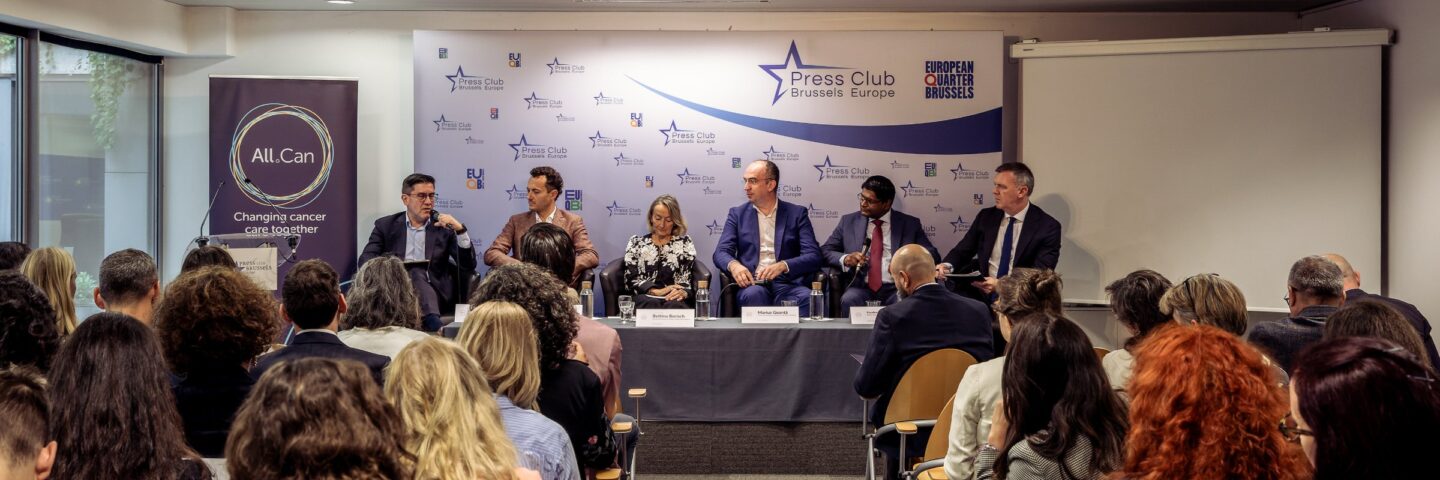
Cancer diagnoses are projected to rise by nearly 77 per cent by 2050. No health system can absorb that by doing more of the same. On 13 October 2026, the All.Can Global Dialogues brought together the All.Can community, patient organisations, healthcare professionals, researchers, policymakers and industry partners for a working day in Brussels on how cancer care can become both better for people and more sustainable for the systems that fund it.
Speakers joined from All.Can Colombia, All.Can Mexico, All.Can Canada, All.Can Romania and across Europe, with others connecting online from Australia, Malta and Geneva. 80 participants joined in the room and more than 400 watched online in the first 24 hours, carrying the discussion well beyond Brussels.
The day was anchored in All.Can’s 2026 global report, Implementing Person-Centred Cancer Care to Improve Outcomes, Experiences and Efficiency, which draws on evidence from 11 countries and sets out a seven-step pathway for reform. The evidence for what works already exists, so the discussion focused on implementation: what it takes in practice, how it is financed, and what has to change for it to become the norm.
The morning, moderated by Rapporteur, ran across two linked sessions, on implementation and on financing and sustainability. The afternoon turned to cancer literacy, tested against one decision that health systems handle unevenly, and closed on the eve of the inaugural Cancer Literacy Day.
Key messages
- The gap between what we know and what we do is a choice. Most countries now have a national cancer plan; far fewer cost it, fund it or measure whether it works.
- Coordination is where efficiency lives. In Cali, Colombia, better coordination cut dropout in the breast cancer diagnostic pathway from 53% to 20% in around ten months, and participants voted care coordinated across services as the top priority.
- Measurement protects cancer plans. Data on outcomes and patient experience is what convinces finance ministries and keeps services running once pilot funding ends.
- Literacy is a shared responsibility. Through Elena, a fictional woman invited to breast cancer screening for the first time, participants explored how systems can fit people better, from the invitation letter to the result.
All.Can also signed a memorandum of understanding with City Cancer Challenge (C/Can), joining policy and practice to close the implementation gap.
Media coverage
Rapporteur, media partner of the event, published a post-event article on the discussions: Cancer plans stall without political will and lasting funding, experts warn (20 October 2026).
Watch the recording
The full day was streamed live by Rapporteur. The recording is available on YouTube.
We thank Siemens Healthineers for supporting the session on cancer literacy and breast cancer, Rapporteur for the moderation and livestream, and City Cancer Challenge (C/Can), our knowledge partner.
About All.Can and Our Supporters
All.Can is an international multi-stakeholder initiative working to improve the efficiency of cancer care by focusing on what matters most to patients. Our work, including this event and the publication of our global report, is made possible thanks to financial support from our funding partners:
Bristol Myers Squibb, Roche, MSD, Johnson & Johnson, BeOne Medicines, and Exact Sciences.
For further information regarding the event or the report, please contact the All.Can Secretariat at secretariat@all-can.org.