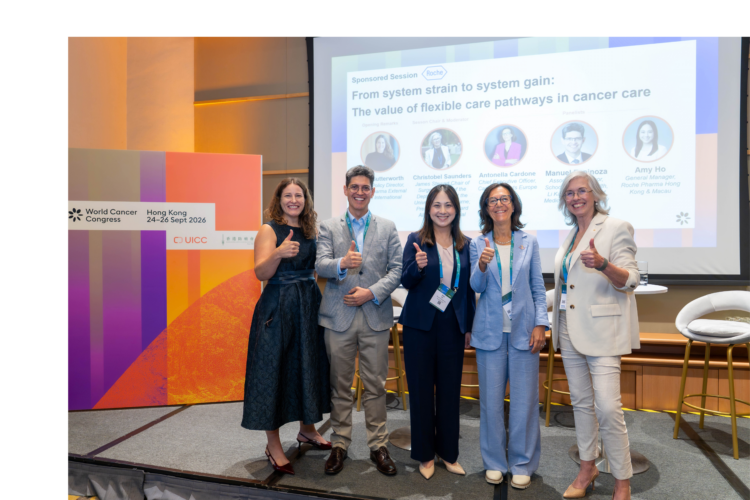
At the World Cancer Congress 2026, global oncology leaders convened for a Roche-sponsored session titled “From System Strain to System Gain: The Value of Flexible Care Pathways in Cancer Care”. All.Can’s Board President, Professor Christobel Saunders, chaired the panel session which explored how healthcare frameworks can evolve to alleviate capacity pressures and better serve patients.
The discussion featured diverse perspectives from Antonella Cardone, CEO of Cancer Patients Europe; Professor Manuel Espinoza from the University of Hong Kong; and Amy Ho, General Manager of Roche Pharma Hong Kong & Macau.
A central theme of the session was the urgent need to redefine value in cancer care to align with actual patient experiences. Industry leaders noted that treating patients at the right time and place – such as shifting stable patients to community care, utilising at-home testing, and adopting time-saving subcutaneous injections – can improve patient experience and outcomes and has the added benefit of reducing reliance on outdated and legacy healthcare pathways.
These flexible models are already showing success; for example, a program in Chile shifted care for low- and medium-risk patients to primary care settings and digital platforms, generating a 12% savings in overall expenditure while maintaining high-quality outcomes. Panelists were confident that deploying flexible care pathways can address strains on the healthcare system and unlock capacity.
Despite the existence of successful pilot programs, systematically scaling these flexible models remains a significant challenge. The panel argued that the political will combined with creative financial incentives can overcome challenges to implementing these pathways.
We’ve seen that when global emergencies like the COVID-19 pandemic occur, or defense needs arise, governments rapidly mobilise massive resources, proving that sweeping system overhauls are possible when political motivation exists.
To build this political will – not only with Health Ministers but across government -, stakeholders across the healthcare spectrum must collaborate to craft a unified, compelling narrative that demonstrates how flexible care models make economic, social, and clinical sense.
Policymakers need to hear cohesive stories that clearly illustrate the tangible benefits of transitioning care closer to home. Furthermore, by grouping countries with similar healthcare maturity levels, regions can share actionable learnings and best practices to implement these changes more efficiently.
Ultimately, advancing person-centered care requires moving from reactive crisis management to proactive, cross-sector collaboration that places patient voices at the very center of healthcare design.
Panelists highlighted resources that are providing the blueprint and best practices for this people-centered flexible care approach, including:
- The All.Can People Centered Cancer Care Report
- Cancer Patients Europe survey on patient expectations for the future of cancer treatment
- Roche co-authored peer-reviewed journal article in Frontiers in Health entitled “Barriers and enablers for health system reform”