Finding cancer early saves lives. Does it also make economic sense? New research commissioned by Mission Early, presented in preliminary form at its side session at the 2026 World Cancer Congress in Hong Kong, suggests it does in most cases, under important conditions.
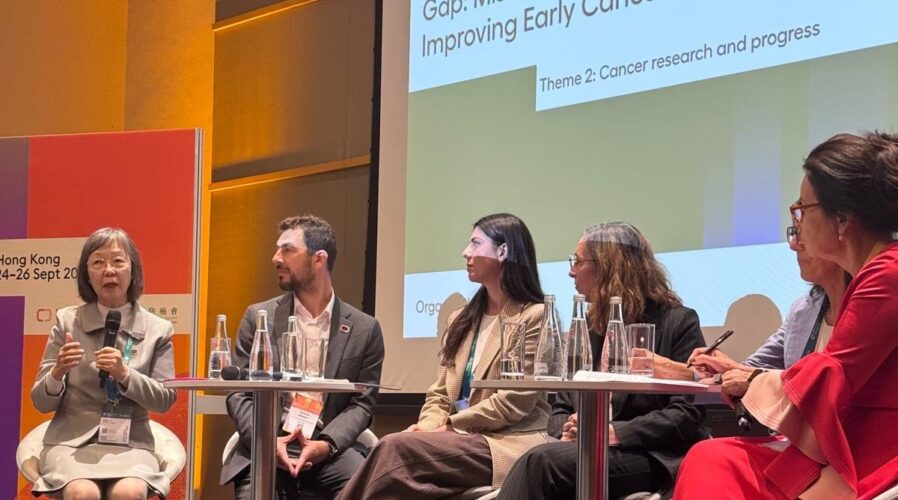
On 25 September, partners, advocates and policymakers joined us for Closing the Gap: Mission Early’s Blueprint for Improving Early Cancer Care Worldwide. We shared new evidence, set out where Mission Early is heading, and heard how partners are turning that evidence into policy action across Europe and Latin America.
Early results of the investment case
After opening remarks from UICC’s Cary Adams, Katya Nogales of Triangulate Health presented preliminary results from the research. Its aim is to give health and finance ministers clear evidence on the economic returns of early cancer detection, in a field where existing studies are fragmented and almost all come from high income countries.
So far, the review has mapped 70 studies published between 2015 and 2026, covering screening and early diagnosis across six cancer types and 14 countries. It looks at four dimensions of economic benefit: value for money, affordability, societal return on investment, and wider economic value to patients and families.
These preliminary findings cover detection and screening only. The researchers are developing further analysis and recommendations on early treatment for the final report.
What the evidence shows so far
Where evidence exists, organised screening and early diagnosis offer better value than no intervention or usual care. The strength of the case depends on the cancer and on how the programme is designed.
Programme design emerged as the common thread. Who is screened, how often, with which test, and how many people take part mattered more than the country of delivery.
The research was equally candid about the gaps. No study measured a full societal return on investment, and only one study, covering a single country, came from a low or middle income setting.
What it means for policy
The central message for health and finance ministers: where the evidence exists, investing in early cancer care is good value for money, and for some interventions it saves money outright. For advocates, three implications stand out.
- Make the investment case. Spending on screening and early diagnosis can reduce the far higher costs of late stage disease. Detection and treatment capacity belong in the same investment plan.
- Fill the evidence gaps. Where country specific economic data are scarce, as in many low and middle income countries, advocates can draw on transferable evidence and press for investment in local data.
- Plan for upfront costs. Some cost effective programmes need significant early spending. Building it into budget and replenishment cycles is key to sustaining political will.
From evidence to action
Alexander Roediger of MSD then set out how Mission Early’s strategy for 2026 to 2028 will move from building the evidence base to using it. Speaking as one partner in a broad coalition, he stressed that no single organisation can close the early detection gap alone. A panel moderated by Maira Caleci (UICC Board and FEMAMA) brought that shift to life, with contributions from Cancer Patients Europe, All.Can International, UICC’s lung and breast cancer early detection work, and the Hong Kong Cancer Society.
How All.Can is putting the evidence to work
Mădălina Iamandei, Executive Director of All.Can International, described how Mission Early takes root through All.Can’s National Initiatives in Mexico, Romania and Spain. In September 2025, All.Can Mexico convened the Mission Early Colloquium at the UNAM School of Medicine, bringing together the heads of Mexico’s national health institutes. The discussion centred on one national figure: 80% of women with cervical cancer in Mexico are diagnosed at an advanced stage. That conversation is now shaping a policy roadmap for early cancer care in women. All.Can Romania launched its Mission Early programme at the end of 2025, mapping where people fall through the gaps before diagnosis. All.Can Spain is working region by region, where screening decisions are taken.
Her message to the room was simple: global evidence gets you the meeting, national evidence gets you the decision. Early detection pays back after the electoral cycle, and the budget line that invests is rarely the one that saves. Localised investment cases help bridge that gap, which is why All.Can is asking partners for national data and for access to finance ministries.
All.Can has committed to bringing the investment case to its National Initiatives in all three Mission Early countries before the next World Cancer Congress in 2028. The work began in Brussels on 13 October, when the economic case was presented to our community at the All.Can Global Dialogues.