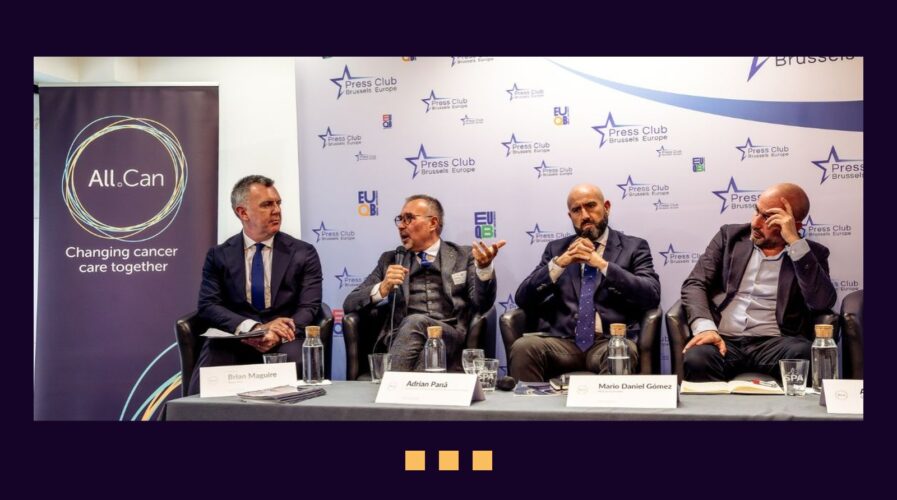
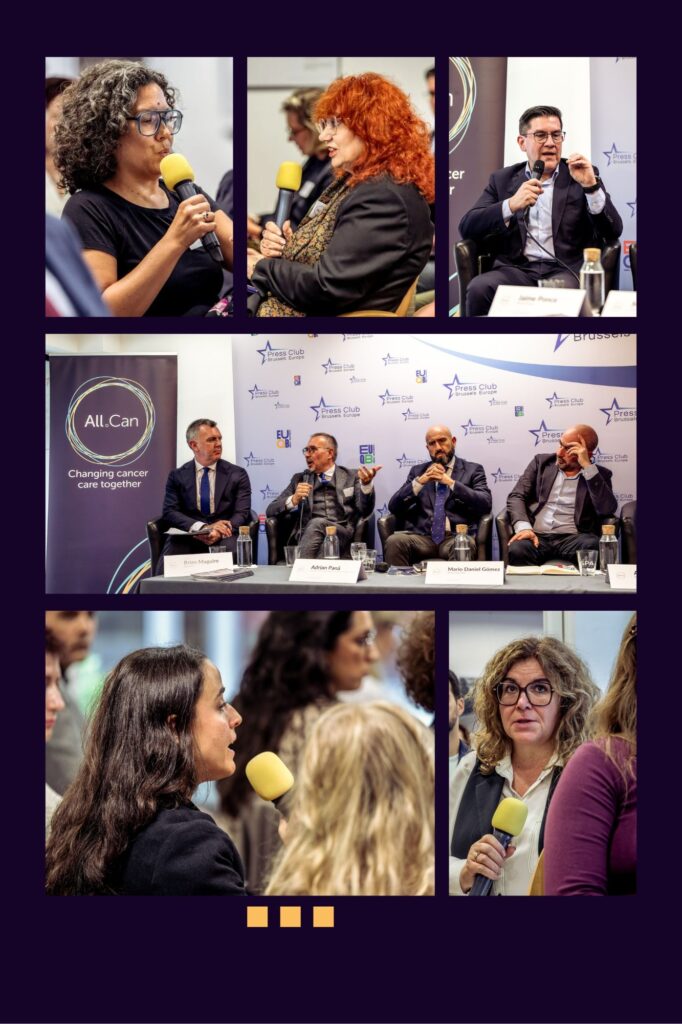
On 13 October 2026, the All.Can Global Dialogues brought 80 participants to The Press Club Brussels and more than 400 online viewers to a day of discussion on rethinking cancer care around the person. The day was anchored in All.Can’s 2026 report on implementing person-centred cancer care to improve outcomes, experiences and efficiency. Some of the most concrete contributions came from the All.Can National Initiatives in Mexico, Canada, Spain, Romania, Colombia, Poland and Greece, whose representatives described how evidence is being turned into change in seven very different health systems.
Their accounts, summarised below, share a common thread. Each starts from a structured understanding of where the system falls short, and each uses that understanding to reach the people who decide how resources are allocated.
Implementation: Mexico, Canada and Spain
Mexico: using the diagnosis to drive action
In Mexico many people receive a late diagnosis and late treatment for cancer, the result of a highly fragmented health system and low public investment in health, at a time when demand for treatment will rise. That is why All.Can Mexico, whose secretariat sits at the Mexican Health Foundation, FUNSALUD, piloted the Action Guide for Efficient Cancer Care together with Greece and Australia. The pilots found common patterns across continents and across health systems of different maturity: governments have strategic intentions in place, yet when these are translated into concrete actions, the results in quality of care, quality of life and outcomes do not follow.
Mexico has important building blocks, including a national cancer plan, improving cancer registries and dedicated treatment centres. The task is to use them together. The pilot pointed to standardised times from diagnosis to treatment, a unique patient identifier as the basis for an interoperable system, patient navigation and, above all, the patient voice through PREMs and PROMs, which are not yet implemented in the country. All.Can Mexico is turning this information into action with government, working closely with the Mexican Social Security Institute, which covers more than 70 million people, to standardise times to diagnosis and treatment, and with civil society to raise awareness of different cancers, especially among women.
Canada: testing readiness for efficient cancer care in Québec
Drawing on the experience of colleagues in Mexico, Greece and Australia, All.Can Canada is implementing the Action Guide in the province of Québec. The choice of a single province reflects the structure of Canadian healthcare, which is organised at provincial and territorial level alongside federal programmes for specific populations such as refugees, First Nations and Inuit with Crown treaties, military personnel and veterans, and federally incarcerated individuals.
All.Can Canada is going one step further by focusing on three regions within Québec, with earlier lung cancer diagnosis as the central theme. Lung cancer is the leading cause of cancer death both in Canada and in Québec, and more than half of all diagnoses are made at a late stage. The three regions were chosen for their differences: an urban centre that serves as a major referral site for rural and remote parts of the province, a region with a large factory that creates workplace risk alongside radon exposure linked to the Canadian Shield, and a region combining radon exposure with significant Indigenous communities. This diversity will allow the initiative to examine how lung cancer diagnosis can become both more timely and more equitable, with a future demonstration project as the intended outcome.
Spain: bringing long-term cancer survivors into regional health policy
All.Can Spain works to identify inefficiencies in cancer care and promote actionable and feasible solutions to improve the quality, efficiency and sustainability of cancer care. Throughout 2026, its efforts have centred on the quality of life of long-term cancer survivors, translating the recommendations of its Scientific Committee into concrete policy initiatives at regional level.
Activities have focused on the Community of Madrid and the Valencian Community, working with healthcare spokespersons from the Health Committees of both regional parliaments. All.Can Spain has contributed to the inclusion of long-term cancer survivors’ needs in the regional budget and provided input into the development of the Community of Madrid’s plan for long-term cancer survivors. The result is that the needs of this growing group of patients now feature among regional health policy priorities.
Financing: Romania, Colombia, Poland and Greece
Romania: a cancer plan in law needs measurement to survive
All.Can Romania brought what its representative called uncomfortable data. Romania has one of the worst records in the EU for avoidable mortality, with treatable mortality the highest against the EU average, and is among the countries that spend least per patient. Although cancer incidence is below the European average, cancer mortality in men is 10% higher. The gap is lost to late diagnosis, fragmented care and missing data. Romania has had a national cancer plan written into law since 2023, yet the plan is not followed because it lacks the tools to monitor it.
All.Can Romania has just started the Romanian edition of the Action Guide, and its first finding is that most of the Guide’s eight indicators cannot be computed from routine national data. The response proposed in Brussels had three parts: a functional national cancer registry linked with screening registries, insurance claims and the mortality registry, which costs little; a transition from EU-funded screening pilots to national, population-based organised screening; and better coordination, since tumour boards and navigation outside the big university cities remain a challenge. What protects a cancer plan, in this view, is a short list of indicators published every year by an independent public body and tied to the budget line, measuring what happens to the person across the whole pathway rather than the activity alone. Budgets get cut when results are invisible.
Colombia: planning for the long term, with patients in the room
All.Can Colombia asked why the sustainability of healthcare is always in question when no one asks the same of other policies. Looking at the burden of cancer to 2030 and 2050, the real question is how to bring new technologies to the population with limited resources, and how to be more efficient in doing so. In Colombia the challenge is sharpened by the fact that health is a fundamental right and every citizen is financially protected: the government has to pay for any existing technology, which places real demands on the finance and health ministries.
Colombia is unusual in Latin America for its long-term planning across policy areas. A ten-year public health plan with a dedicated cancer chapter was followed, after learning from what worked and what did not, by a dedicated ten-year cancer plan. All.Can Colombia supported that process in working groups and round tables by bringing together patients, who know better than anyone what should be prioritised, along with academia, scientific societies and the healthcare industry. The National Cancer Institute of Colombia, a member of All.Can Colombia, both provides top-level care and leads national cancer policy. The plan is expected to help Colombia improve its indicators by 2030 and 2050 and, in the words of its representative, lets the country anticipate the tsunami it can see approaching from the shore.
Poland: ten years of connecting expert knowledge with patient experience
All.Can Poland has been active for ten years, working to improve the quality and efficiency of oncology care, and since 2024 haematology and care for children with cancer as well. The initiative brings together patients, clinicians and other experts, decision makers, medical companies and media. Its membership now exceeds 60, and it has published 13 studies and reports that connect expert knowledge with patient experience. Each year it publishes a report diagnosing changes in oncology and haematology care, taking stock of the past year’s achievements and setting out the challenges and needs for the year ahead.
Personalised medicine is an important part of this work. In 2026, All.Can Poland published a major report on individualised therapy as the foundation for optimising the treatment of haematology patients, prepared with a broad group of haematology experts. Its central finding is that access to innovative medicines on its own will not deliver their full benefit. Proper diagnostics, organisation and financing are needed too, and in Poland this means molecular diagnostics, outpatient care and coordination. Dialogue with decision makers is essential to this approach: All.Can Poland presents its reports at the parliamentary oncology group and in meetings with policymakers, to translate expert knowledge into concrete change.
Greece: from mapping the system to shaping the National Cancer Action Plan
All.Can Greece, led by ELLOK, the Hellenic Cancer Federation, offered a practical illustration of what connecting better outcomes and patient experiences with more efficient use of resources can mean for a national cancer plan.
Through its pilot implementation of the Action Guide, All.Can Greece assessed eight oncology hospitals and clinics. The results, presented in November 2025 and published in a final report in February 2026, gave a structured picture of the strengths and weaknesses of cancer services, the challenges shared across settings, and where improvement and investment were needed. The value went beyond the mapping itself. The dialogue it generated helped ELLOK bring this evidence into discussions on the National Cancer Action Plan, supporting the working group in identifying priorities and areas for action.
A complementary study on the cancer patients’ perspective, conducted in 2025 and presented in March 2026, reinforced the importance of looking beyond clinical indicators to understand how people experience their care and their health. Together, this work highlighted the need for clearer care pathways, better monitoring of waiting times and performance, stronger coordination between services and greater patient involvement. As All.Can Greece put it, this is how evidence can help a national cancer plan move forward: by giving stakeholders a shared understanding of where the system needs to improve, helping identify where investment is most needed, and ensuring that progress is measured by the outcomes and experiences that matter to patients as well as by what the system delivers.
A shared approach
Seven countries, seven very different health systems, and one recognisable method: assess the system honestly, build the evidence with patients and experts together, and take it to the people who hold the budget and write the plan. Four of the seven are now working with the Action Guide for Efficient Cancer Care, and the others are reaching the same destination through national reports, regional budgets and ten-year plans. This is what All.Can means by efficiency, focusing resources on what matters to patients, and the National Initiatives are where that principle meets practice. All.Can International will continue to support this work and to share it across the network.